
SELECT * FROM ipaccess WHERE ip = '38.107.191.101'
Ripe for recovery? | Economic OutlookPDF
The New Zealand economy is slowly hauling itself off the couch and getting moving again.  GDP growth will look impressive over the next two years, averaging 4%pa, but it’s worth remembering that the economy is currently smaller than it was at the start of 2007.
Forecast Story
The New Zealand economy is gradually emerging from the recession of the last two years, but the recovery so far has failed to live up to general expectations, if confidence surveys are anything to go by.  With the labour market still weak, the housing market’s resurgence losing momentum, and question-marks about the robustness of the global economy, the Reserve Bank is under less pressure to raise interest rates as rapidly as we previously expected.  Nevertheless, the sustained fiscal and monetary stimulus will see economic activity accelerate noticeably over the second half of this year, with GDP growth averaging 4%pa over the two years to March 2012.  This pick-up is not the beginning of John Key’s fabled “step change”, however – the government’s predisposition to adopt a pragmatic and low-risk approach to policy means we see little chance of improvement in New Zealand’s medium-term growth prospects.
Household Forecasts
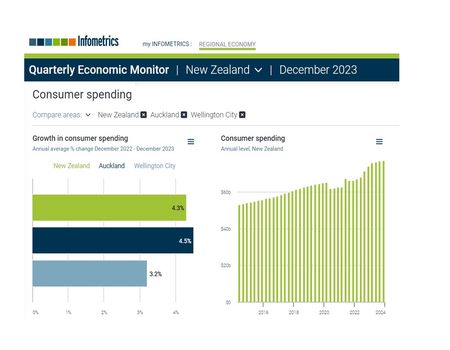
Just when it looked like a recovery in house prices would prevent households from being forced to “balance the books”, a sharp increase in unemployment, a shift in the tax mix towards consumption taxes, and growing uncertainty about the housing market have now convinced households to remain relatively cautious. Although falling unemployment and a recovering economy will lead to renewed growth in consumption, household spending is likely to stay below historical trends for some time.
Business Issues Forecasts
Even though we are nearly a year out of recession the New Zealand economy still appears anaemic at best.  Investment is low, credit conditions remain surprisingly restrictive for some borrowers, and uncertainty regarding domestic policy and the international recovery is elevated.  The patchiness of the recovery will ensure that cost growth remains soft.  However, profitability and investment will remain below levels consistent with normal economic growth.
Financial Markets Forecasts
With plenty of spare capacity in the labour market, domestic price pressures have ebbed to an eight-year low.  Abstracting from a GST-induced spike in 2011, inflation is set to remain comfortably within the target bank throughout the forecast period.  A run of concerns about the global economy, combined with some weaker domestic data, means that the Reserve Bank is likely to hold off until June before increasing the official cash rate.  However, interest rates will rise from mid-2010 as monetary settings are gradually returned to normal and financial markets place a greater risk premium on corporate and government debt, particularly the latter.
Fiscal Forecasts
Tax reform took centre stage when preparing our November 2009 forecasts, and it remains the primary issue for this latest publication.  Further information has come to light about what the government may unveil in the May budget, but our baseline assumptions remain little changed.  We expect GST to go up to 15%, with a two percentage point reduction in income taxes across the board.  There will also be adjustments to other tax and benefit rates, and property investors are nervously waiting for the government to confirm the likely removal of depreciation on buildings.  Our outlook for the fiscal accounts is slightly worse than in November, largely due to a weaker outlook for revenue from government-provided goods and services.  But the underlying picture remains similar, and the size of the fiscal deficit will shrink considerably over the next three years.
External Forecasts
The current account deficit has shrunk much faster than we allowed for in our November forecasts.  However, this improvement was largely the result of one-offs and scope for further reductions in the deficit is limited.  As the domestic economy picks up during 2010, imports will also recover.  This recovery in imports, along with a pick-up in dividends to foreign investors, will see the current account deficit expand significantly during 2010.  We estimate a trade surplus has emerged early this year, but this surplus will be eroded later in 2010 as imports recover.  Import price growth will be constrained over the next 1-2 years by spare capacity in the Asian economies.  Relatively high commodity prices will coincide with this weak import price growth, leading to a substantial recovery in the terms of trade over the next two years.
International Forecasts
The speed and timing of the global economic recovery is a key factor that will determine New Zealand’s own economic fortunes over the year ahead.  After a period of weakness the tide has turned, with growth in many of our major trading partners already picking up.  We expect the average size of our main export market to expand by 3.7% over 2010, and the risks to this outlook are now balanced, rather than on the downside.  Although the effects of write-downs in Europe and America could be worse than expected, stronger growth in demand for commodities could further boost growth in commodity-exporting countries such as New Zealand.  The global recovery is still very dependent on government stimulus, and this stimulus will need to be withdrawn gradually to avoid choking the recovery.  Leaving aside Australia, the rest of our major trading partners will start raising interest rates from late 2010 to early 2011.

Recent releases

Economic
Terms of trade 10/03/2010
Dec qtr 09 | a.p.c: -8.2%
Manufacturing 8/03/2010
Dec qtr 09 | real output q.p.c: 7.2%
Tourism 1/03/2010
Jan 10 | arrivals a.p.c: 5.2%
Exports / imports 26/02/2010
Jan 10 | annual balance: -$178m
Government accounts 19/02/2010
Dec 09 | OBEGAL ytd: -$3.68bn
Producer prices 16/02/2010
Dec qtr 09 | inputs a.p.c: -3.3%
Retail sales 12/02/2010
Dec qtr 09 | excl. auto a.p.c: 1.7%
Employment 4/02/2010
Dec qtr 09 | unemployment rate: 7.3%
Labour market 2/02/2010
Dec qtr 09 | Unadjusted LCI a.p.c: 2.9%
Borrowing / lending 28/01/2010
Dec qtr 09 | housing debt a.p.c: 3.3%
Monetary policy 28/01/2010
Jan 10 | OCR: 2.50% (prev. 2.50%)
CPI - inflation 20/01/2010
Dec qtr 09 | a.p.c: 2.0%
GDP 23/12/2009
Sep qtr 09 | production a.a.p.c: -2.2%
Balance of payments 22/12/2009
Sep qtr 09 | deficit as % of GDP: 3.1%
Fiscal update 15/12/2009
Dec 09 | OBEGAL ye forecast: -$7.47bn

Building
Work put in place 8/03/2010
Dec qtr 09 | total real q.p.c: 0.7%
House prices 8/03/2010
Feb 10 | a.p.c: 5.5%
Migration 1/03/2010
Jan 10 | annual (net): 22,588
Non-residential building 26/02/2010
Jan 10 | value a.p.c: -38.6%
New dwellings 26/02/2010
Jan 10 | excl. apart a.p.c: 34.2%
Building / vehicle costs 16/02/2010
Dec qtr 09 | residential a.p.c: -0.6%
House sales 12/02/2010
Jan 10 | a.p.c: -1.1%
Residential rents 18/01/2010
Dec qtr 09 | a.p.c. 1.0%

Transport

Retail

Terms of tradeTerms of trade recovery begins in style 10/03/2010
Dec qtr 09 | a.p.c: -8.2%
The merchandise terms of trade rose 5.7% in the December quarter, the largest jump since March 1976. This increase was significantly better than we expected, but it confirms our overall view that the low levels the terms of trade sunk to during 2009 wouldn't last. We expect significant further increases in the terms of trade during 2010.
Electronic transactionsRetail malaise continues 9/03/2010
Feb 10 | a.p.c. 2.6%
The value of February core (non-automotive) retail spending declined 0.2% from January (seasonally adjusted). Durable good spending took the hardest hit, dropping 1.8% from January. These figures indicate that consumers have remained cautious with their spending over the start of 2010.
Financial weeklyDr Bollard's dilemma 5/03/2010
Next Thursday the Reserve Bank is widely expected to keep the official cash rate unchanged at 2.5%. What will be of more interest to markets is how the Reserve Bank's view of the economy has altered, and what this view implies for interest rate settings going forward. Overall we expect the Bank's view to be little changed, and for them to get into the nitty gritty of lifting rates from June 2010, rather than later.

Financial weekly: PDF | Calendar | Strategy | Graphs
Changing the Tax Mix – Why Bother?5/03/2010
Many people do not support an increase in GST, or so the polls tell us. I recall the same popular sentiment in 1986 when GST was first introduced. At that time there was a natural fear about a type of tax that was unfamiliar to most New Zealanders. Would it work? Would politicians deliver the accompanying income tax cuts? Who would gain and who would lose? Would government be bigger or smaller? Perhaps these fears still exist even though the change being talked about this time is much less dramatic.
What is it about the Kiwi dollar?4/03/2010
The swings and roundabouts in the New Zealand dollar were a dominating factor for businesses over 2009.  The New Zealand dollar started the year in free-fall, dropping 15% over January.  But after the monetary floodgates opened, the kiwi staged a massive 44% rally over the next seven months.

Infometrics affiliates

Gareth Morgan Investments Gareth Morgan KiwiSaver Morgan Family Charitable Foundation Infometrics Property